
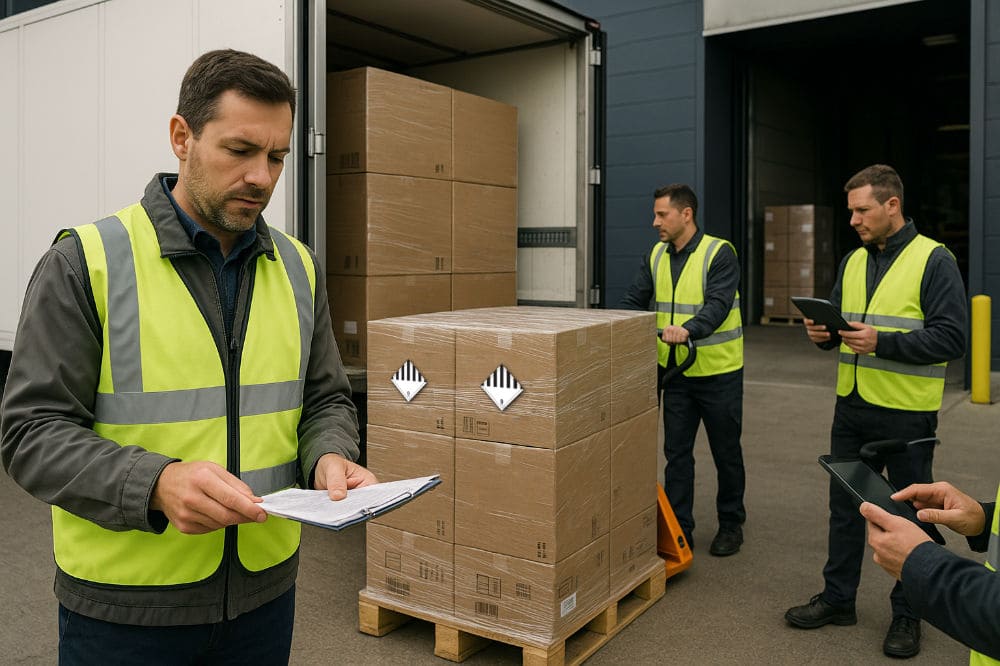
Who Is Responsible in ADR Transport? Key Roles and Safety Obligations
The safe carriage of dangerous goods is never the job of a single person. ADR clearly defines “participants” in the transport chain and allocates specific safety obligations to each of them in Chapter 1.4. Consignor, carrier, loader, packer, filler, tank-container operator, unloader and consignee all have defined duties, and several of these roles may be performed by the same company. 
Consignor – where compliance begins
The consignor is the enterprise that sends dangerous goods, either on its own behalf or for a third party. ADR requires the consignor to hand over for carriage only consignments that conform to ADR. In practice, this includes ensuring that the dangerous goods are correctly classified and authorised for carriage, providing the carrier with accurate and traceable information, and issuing the required transport documents and any necessary approvals or certificates.
The consignor must also use only approved and suitable packagings, IBCs and tanks bearing the prescribed marks, respect dispatch and forwarding restrictions, and ensure that even empty, uncleaned tanks and vehicles are correctly placarded and leakproof. If the consignor uses other participants (packer, loader, filler, etc.), it must take measures to ensure that the whole consignment still meets ADR requirements, although it may rely on information provided by these parties for certain points.
Carrier – safe journey and vehicle condition
The carrier’s role begins once the consignment is accepted for transport. According to ADR, the carrier must verify that the goods are authorised for carriage, that the required information and documentation have been provided and that the prescribed documents are on board the transport unit (or available electronically in an equivalent way).
Before departure, the carrier must visually check that vehicles and loads have no obvious defects, leakages or missing equipment; confirm that tank test dates have not expired; ensure the vehicle is not overloaded; and verify that placards, marks and orange plates required by Chapter 5.3 are correctly affixed. If serious infringements are detected, the carrier must not continue the transport until the problems are resolved. If a safety-critical issue appears during the journey, the consignment must be halted as soon as it is safe to do so and brought back into compliance before continuing.
Loader and packer – how the load is prepared
The loader is responsible for handing over only goods that are authorised for carriage, checking that packagings are not damaged or leaking, complying with loading and handling requirements, and observing mixed loading prohibitions and separation rules from foodstuffs. When loading containers, the loader must ensure that placards, marks and orange plates are applied in line with Chapter 5.3.
The packer, on the other hand, focuses on how goods are put into packages. Under ADR 1.4.3.2, the packer must respect packing and mixed-packing conditions and ensure that packages are correctly marked and labelled when prepared for carriage. Poor packing or missing labels at this stage often leads directly to non-compliance and incidents further down the chain. 
Filler and tank-container operator – tank safety and maintenance
Where dangerous goods are carried in tanks, the filler has a critical role. ADR requires the filler to check that tanks and their equipment are in satisfactory condition, ensure that the next test date has not expired, fill only authorised substances into those tanks, and respect requirements on maximum degree of filling. After filling, the filler must verify that all closures are properly closed, that there are no leakages and that the tank, vehicle or bulk container is correctly placarded and marked. 
The tank-container/portable tank operator is responsible for the construction, equipment, testing, marking and maintenance of the shells and their equipment so that the tank continues to meet ADR requirements between inspections. If repairs, alterations or accidents could compromise safety, the operator must arrange for exceptional checks. 
Unloader and consignee – closing the loop safely
The unloader must ensure that the correct goods are being unloaded by comparing transport documents with the information on the packages, tanks or vehicles. If damage that could endanger unloading is detected, unloading must not proceed until appropriate measures are taken. After unloading, residues on the outside of tanks or vehicles must be removed, closures secured and prescribed cleaning or decontamination carried out. Once containers are completely unloaded, cleaned and decontaminated, they must no longer display placards, marks or orange plates.
The consignee is obliged not to defer acceptance without compelling reasons and to verify, after unloading, that ADR requirements applicable to them have been fulfilled. If checks reveal infringements, the consignee must not return a container to the carrier until they have been remedied. When the consignee uses other participants (such as unloaders or cleaning facilities), they must ensure that those obligations are also met.
Why clear roles matter
ADR emphasises that all participants must take appropriate measures, according to the nature and extent of foreseeable dangers, to avoid damage and where necessary, to minimise consequences. Clearly defined responsibilities help prevent gaps: classification errors at the consignor stage, poor packing or loading practices, missing placards, or a lack of checks during unloading.
For companies, turning these legal obligations into clear internal procedures, training and checklists is essential. Staff must be trained according to their functions, as required by ADR Chapter 1.3 and records of that training must be kept. When everyone understands their role in the chain, compliance becomes more predictable, inspections run more smoothly and, most importantly, the risk to people, the environment and property is significantly reduced.